Children's Education in Computing Exploration

CECE Lab | K-12 AI in Education

Eight educators present their AI-integrated classroom projects at NSEA 2026.
Final Presentations: Saturday, July 25, 2026 | Ballroom A & B, University Student Center

Explore the Projects

About the CECE Lab

Program Description

The Children's Education in Computing Exploration (CECE) Lab at the Center for Equitable AI and Machine Learning Systems (CEAMLS) is committed to advancing AI literacy among K-12 educators and students through innovative, hands-on learning experiences. The AI in Education Initiative includes a Teacher Professional Development Program that equips educators with the knowledge and confidence to integrate AI into classroom instruction, alongside a Student Program that introduces learners to artificial intelligence, ethical AI, and real-world problem-solving through engaging, project-based activities.

The AI in Education Symposium celebrates the impact of these programs by bringing together educators, students, school leaders, families, and community partners, where participating teachers present their AI-integrated classroom projects and showcase student learning outcomes.

8
Teacher Presentations
3 to 11
Grade Levels
6
Subject Areas
Day 1
Saturday, July 25

Teacher Presentations

All presentations take place on Saturday, July 25, 2026 in Ballroom A & B at the University Student Center. Schedule is subject to change.

5th Grade Science

Ecosystem Explorers: Investigating Biotic and Abiotic Worlds with AI

Tiffany Blizzard

90-Second Project Spotlight

Problem

Students often struggle to distinguish between living and nonliving components of ecosystems and explain how they interact to support life.

Solution

Ecosystem Explorers engages students in analyzing ecosystem images, collaboratively classifying biotic and abiotic components, and using AI to verify and explain their scientific reasoning. Students organize ideas in Freeform, create presentations, and critically evaluate AI responses while maintaining ownership of their learning.

Impact

By integrating AI with scientific inquiry, students strengthen observation, critical thinking, and environmental literacy while learning to responsibly use technology to support evidence-based scientific conclusions.
10th Grade English II

Ethics in the Driver's Seat: Designing AI for Self-Driving Cars

Dominique Bass

90-Second Project Spotlight

Problem

Students often struggle to apply ethical reasoning to real-world technology issues while supporting their opinions with credible evidence.

Solution

Ethics in the Driver's Seat immerses students in the ethical dilemmas surrounding self-driving cars through AI simulations, collaborative investigations, evidence-based writing, and multimedia presentations. Students analyze multiple perspectives, use Apple Intelligence and AI tools to strengthen their reasoning, design ethical decision-making models, and produce an AI Ethics Pitch using iMovie.

Impact

By combining ethical inquiry, artificial intelligence, and persuasive communication, students develop critical thinking, evaluate complex issues from multiple viewpoints, and learn to use AI responsibly while defending evidence-based solutions.

11th Grade

Vision with AI: Protecting Sight Through Responsible Technology

Reven Smith

90-Second Project Spotlight

Problem

Students may understand that AI is used in healthcare, but they often struggle to see how data quality, privacy, bias, and human decision-making affect the accuracy and fairness of medical AI systems.

Solution

20/20 Vision with AI places students inside a healthcare AI challenge where they explore how eye scans can be used to train a diagnostic model. Through the Dusky Dunes simulation, students prepare and label data, protect patient privacy, test model accuracy, collect more diverse data, and examine why doctors must remain involved in AI-supported decisions.

Impact

By connecting computer science with healthcare, students develop a deeper understanding of the AI lifecycle, data ethics, algorithmic fairness, privacy, and the importance of human oversight in high-stakes environments.

4th Grade Science

AR Plant Scientist: Exploring Plant Structures with Augmented Reality

Alexandra Casia

Project Spotlight

Problem

Students often find it difficult to observe and understand plant structures that are hidden or difficult to see through traditional classroom observations alone.

Solution

AR Plant Scientist combines hands-on observation with augmented reality to help students explore interactive 3D plant models alongside real plants. Students investigate plant structures, capture AR screenshots, label observations in Freeform, and explain how each plant part supports survival.

Impact

By integrating augmented reality with scientific investigation, students deepen their understanding of plant structures, strengthen observation skills, and experience how emerging technologies can enhance scientific exploration.

3rd Grade Math

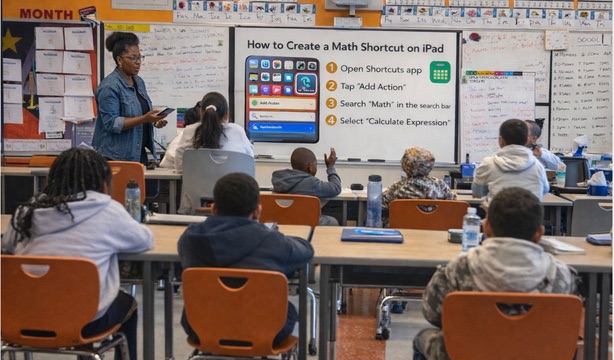
iSolve: AI-Assisted Math Learning with Voice Technology

Rykarra Hill

iSolve: AI-Assisted Math Learning with Voice Technology classroom project

Problem

Many students need immediate feedback while practicing math, but teachers are not always available to provide one-on-one support during independent learning.

Solution

iSolve explores how students can use voice-based AI assistants, such as Siri, to practice multiplication and solve math problems. Students receive instant responses, guidance, and feedback, allowing them to check their understanding and build confidence while learning.

Impact

By providing real-time support and interactive problem-solving opportunities, iSolve makes math learning more engaging, accessible, and personalized. The project demonstrates how everyday AI technologies can be used to enhance student learning and encourage independent practice.

10th Grade

Flight Path AI: Engineering Safer Airplanes Through Simulation

Kyle Burke

Flight Path AI: Engineering Safer Airplanes Through Simulation classroom project

Problem

Students often understand the laws of flight in theory but struggle to connect engineering principles with the growing role of AI in aviation safety and aircraft design.

Solution

Flight Path AI challenges students to investigate real-world aviation case studies, analyze AI's role in aircraft safety, and use AI-powered flight simulations to evaluate airplane designs. Students collaborate in Freeform, research ethical considerations, and apply the principles of thrust, lift, drag, and weight to improve aircraft performance.

Impact

By blending engineering design, AI evaluation, and collaborative problem-solving, students develop technical knowledge, ethical reasoning, and critical thinking while exploring how AI improves modern aviation.

9th Grade ELA

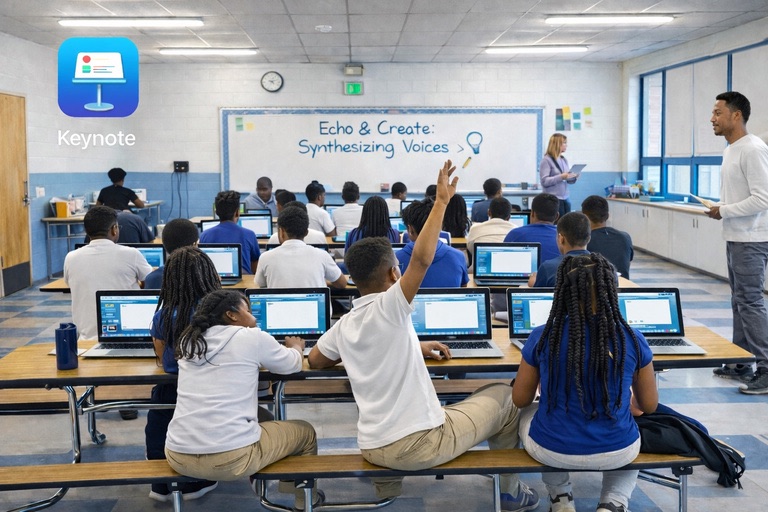
Echo & Create: Synthesizing Voices Through AI

Eneah Fite

Echo & Create: Synthesizing Voices Through AI classroom project

Problem

As AI-generated media becomes more common, students need opportunities to understand voice synthesis technologies and their ethical implications.

Solution

Through a structured Apple Keynote process (Flex, Explore, Express, and Refine), students create and refine audio, video, and narrative content while exploring AI-generated voice technologies.

Impact

The project develops digital literacy, creativity, and critical thinking while encouraging students to examine issues of identity, authenticity, and responsible AI use.

6th Grade

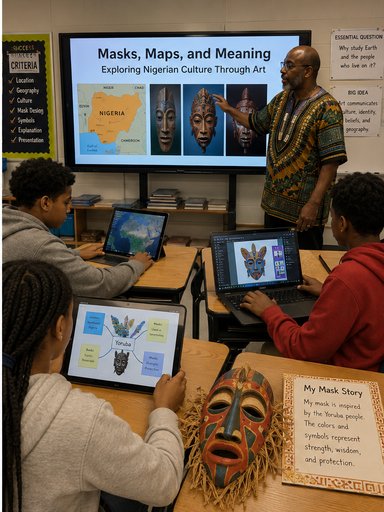
Masks, Maps, and Meaning: Exploring Culture Through Art

Donald Odoms

Masks, Maps, and Meaning: Exploring Culture Through Art classroom project

Problem

Traditional geography instruction can make it difficult for students to understand how place, environment, culture, and artistic expression are connected.

Solution

Masks, Maps, and Meaning invites students to research Nigerian ethnic groups and examine how geography, traditions, beliefs, and community values influence ceremonial mask design. Students analyze cultural examples, investigate geographic context, create an original mask inspired by authentic characteristics, and explain the meaning behind their symbols, colors, and patterns.

Impact

By combining geography, cultural research, art, and digital creation, students strengthen cultural awareness, geographic reasoning, creativity, and respectful communication while learning to evaluate AI-generated information critically.

Presentations: Saturday, July 25 (Day 1) · Awards: 4:00 PM Sunday, July 26, Ballroom A & B (Day 2) · Schedule is subject to change.

For questions about the CECE Lab and K-12 programs, contact: nsea@morgan.edu